Reliable Test Equipment Manufacturer
Reliable Test Equipment Manufacturer

|
Battery Temp-control Short Circuit Tester ZH-SC-50T
Telephone:+86 13018663273
Mail:carleen@sailham.com
|
ZH-SC-50T
1. Introduction.
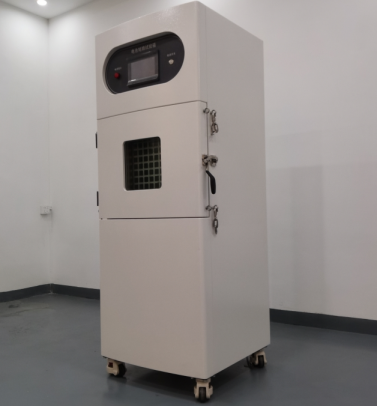
1.1. The Temperature controlled battery short circuit testing machine is designed to meet the requirements of various battery short circuit testing standards, and is short circuited according to the standard requirements, The internal resistance of the circuit device is used to obtain the maximum short-circuit current required for the test; In addition, the circuit design of the short-circuit device must also be able to withstand the impact of high current. Therefore, we have selected industrial grade DC electromagnetic contactors, all copper terminals, and internal copper plates for guidance. The wide and thick copper plates effectively improve the heat dissipation effect, making the high current short-circuit device safer, effectively reducing the loss of testing equipment, and ensuring the accuracy of test data.
1.2. The short circuit testing machine adopts PLC automatic control to simulate external short circuits of batteries, meeting UL1642, UN38.3, IEC62133, GB/T18287, GB/T 31241-2014 and other standards. Record changes in battery voltage, current, and surface temperature. The short-circuit testing machine must have a resistance of 80 ± 20m Ω for the entire circuit (including circuit breakers, wires, and connecting devices), and each circuit must be able to withstand a peak short-circuit current of up to 1000A. Short circuit stop mode can be selected: 1) Short circuit time; 2) Surface temperature of the battery.
2. Conforms to the standard
l GB 31241-2014 "Safety requirements for lithium-ion batteries and battery packs for portable electronic products"
l MT/T 1051-2007 "Lithium ion batteries for mining lamps"
l SJ/T 11169-1998 (UL1642:1995) "Safety Standard for Household and Commercial Batteries"
l YD 1268-2003 "Safety Requirements and Test Methods for Lithium Batteries and Chargers in Mobile Communication Handheld Devices"
l GB/T 19521.11-2005 "Safety Specification for Inspection of Dangerous Characteristics of Lithium Battery Pack Dangerous Goods"
l GB/T 18287-2013 General specification for lithium-ion batteries for cellular phones
l SJ/T 11170-1998 (UL2054:1997) "Safety Standard for Household and Commercial Batteries"
l UN 38.3 Recommendations on the Transport of Dangerous Goods - Manual of Tests and Criteria, Part III, Section 38.3
l UL 1642 "Lithium Battery Standard" 2054 "Household and Commercial Battery Pack"
l IEC62133-2012 "Storage batteries and battery packs containing alkaline or non acidic electrolytes - Safety requirements for sealed batteries and battery packs for portable devices"
l GB/T 8897.4-2008 (IEC 60086-4:2007) "Primary batteries - Part 4: Safety requirements for lithium batteries"
l YDB 032-2009 "Backup Lithium ion Battery Pack for Communication"
l YD/T 2344.1-2011 "Lithium iron phosphate battery pack for communication - Part 1: Integrated battery pack"
l GB/T 21966-2008 (IEC 62281:2004) "Safety Requirements for Lithium Primary and Secondary Batteries during Transport"
l GB38031-2020 "Safety Requirements for Power Batteries for Electric Vehicles"
Test standard requirements:
1) External short circuit at room temperature: (Control the ambient temperature to reach 20 ℃± 5 ℃)
After fully charging the battery according to the prescribed test method, place it in an environment of 20 ℃+5 ℃, wait for the surface temperature of the battery to reach 20 ℃+5 ℃, and then place it for another 30 minutes. Then connect the positive and negative terminals of the battery with wires and ensure that the total external resistance is 80m Ω ± 20m Ω. During the experiment, monitor the temperature changes of the battery. If one of the following two situations occurs, the experiment will be terminated:
a) The battery temperature drops to 20% below the peak value;
b) The short circuit time reaches 24 hours.
Test results: The battery should not ignite or explode, and the maximum temperature should not exceed 150 ℃.
2) High temperature external short circuit:
After fully charging the battery according to the prescribed test method, place it in an environment of 55℃±5℃, wait for the battery temperature to reach 55℃±5℃, and then place it for another 30 minutes. Then connect the positive and negative terminals of the battery with wires and ensure that the total external resistance is 80m Ω± 20m Ω. During the experiment, monitor the temperature changes of the battery. If one of the following two situations occurs, the experiment will be terminated.
a) The battery temperature drops to 20% below the peak value;
b) The short circuit time reaches 24 hours.
Test results: The battery should not ignite or explode, and the maximum temperature should not exceed 150 ℃.
Note: The temperature coefficient of electrical resistivity of the wire is less than 5x10 ℃, such as copper wire.
3. Technical parameters.
1) Inner size: W500 x D500 x H500 mm; (other sizes are available)
2) Control mode: PLC touch screen control+wireless remote control short-circuit action command;
3) Temp. Control range: RT+10℃~85℃;
4) Temperature fluctuation: ±0.5℃;
5) Temperature deviation: ±2℃;
6) Working voltage: AC 220V 50Hz~60Hz;
7) impulse voltage: AC 1kv/1.2-50 μ s (peak) for 1 minute;
8) Maximum short circuit current: 1000A (maximum current can be specified and customized);
9) DC response time: ≤5μs;
10) Device internal resistance: 80mΩ±20mΩ;
11) Action time: Suction time/release time ≯ 30ms;
12) Operating characteristic: Cold state suction voltage ≯ 66% Us;
13) Cold release voltage: ≯30%Us, ≮5%Us;
14) Inner material: Stainless steel plate with a thickness of 1.2mm and coated with Teflon, with strong corrosion resistance and flame retardancy;
15) External material: A3 cold plate baked paint treatment with a thickness of 1.5 mm
16) Viewing window: 250x200mm double-layer vacuum tempered glass observation window, equipped with explosion-proof mesh;
17) Pressure relief and exhaust: The rear side of the box is equipped with a pressure relief device and an exhaust outlet;
18) Door-open method: open the single door from left to right
19) Door switch: Power-off threshold switch to ensure no misoperation and ensure personnel safety;
20) Test hole: There is a 50mm testing hole on the left or right side of the machine, which is convenient for placing various temperature, voltage, and current acquisition cables;
21) Caster wheels: There are four swivel casters under the device, which can move freely;
22) Voltage acquisition:
Voltage range: 0~100V
Collection rate: 100ms
Number of channels: 1 channel
Accuracy: ± 0.8% F.S (0~100V)
23) Current collection:
Current range: 0~1000A DCA
Collection rate: 100ms
Number of channels: 1 channel
Accuracy: ± 0.5% F.S
24) Battery temperature collection:
Temperature range: 0 ℃~1000 ℃
Collection rate: 100ms
Number of channels: 1 channel
Accuracy: ± 2 ℃
25) Short circuit contactor lifespan: 300000 times
26) Data export: There is a USB data export port, which can export reports, view test data and curves
27) Power supply: 220V, 50Hz, 1ph, 2.5 KW
28) External size: W750 x D800 x H1800 mm
29) Device optional to purchase: Manual and automatic fire extinguishing functions
4. Accessories with equipment to be delivered:
l Instruction manual, Certificate of conformity, warranty certificate
l Temperature controlled battery short-circuit testing machine, fixture
5. Environmental requirements for use
Spec. | Requirements |
Ambient temperature & humidity | Temperature≤45 ℃, humidity≤80% |
Power supply | AC220V, 50/60Hz |
Water source | No |
Vacuum | No |
Compressed air | No |
Ground requirements and load-bearing requirements | Concrete floor ≥ 300KG |
Internet requirements | No |
Construction requirements for wastewater treatment plant, smoke, dust, exhaust gas | Exhaust gas exhaust interface φ 75mm |
Phone
+86 13018663273
carleen@sailham.com