Reliable Test Equipment Manufacturer
Reliable Test Equipment Manufacturer
|
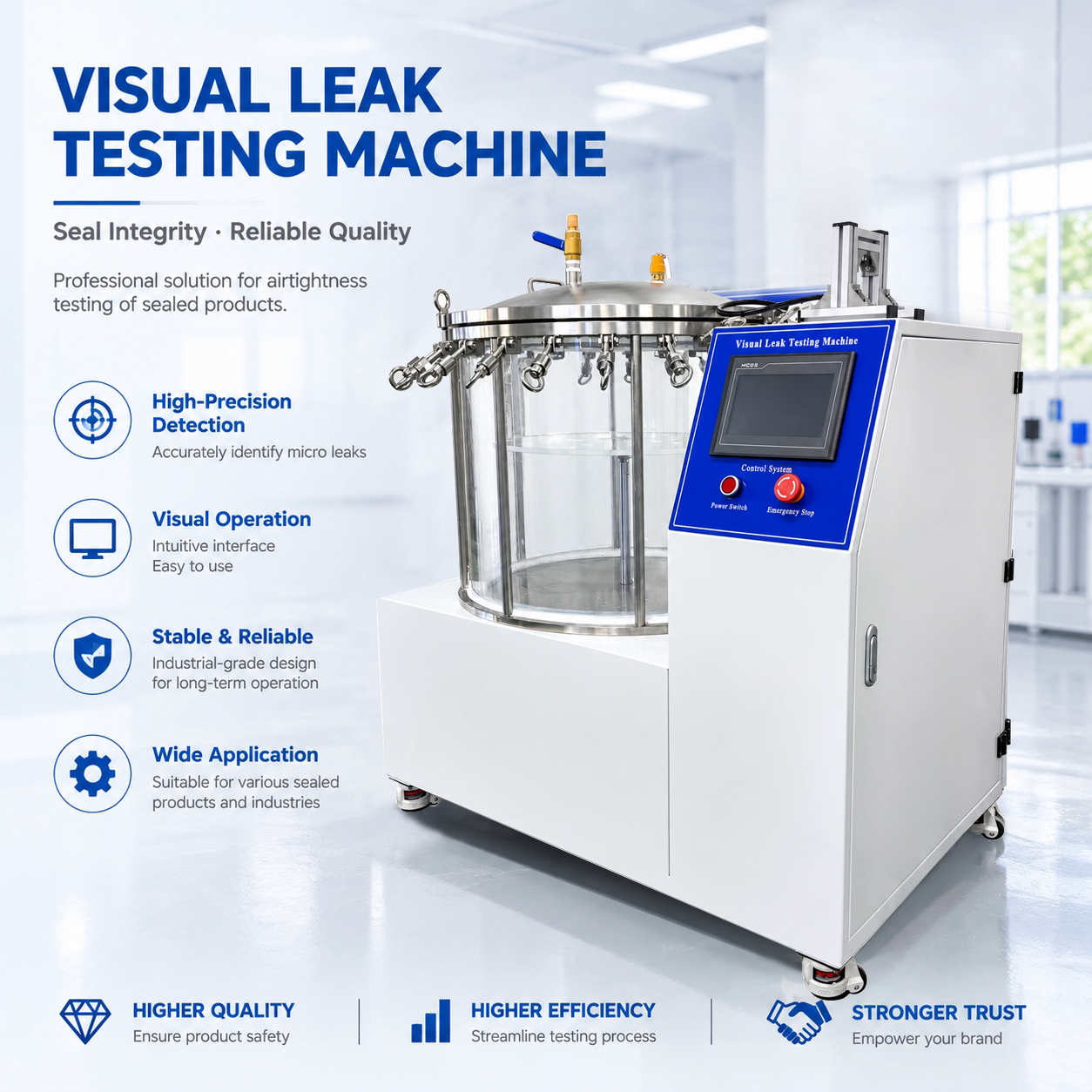
Visual Leak Detection Tester Hardware Electronics Sealing Test Equipment
Telephone:+86 13018663273
Mail:carleen@sailham.com
|
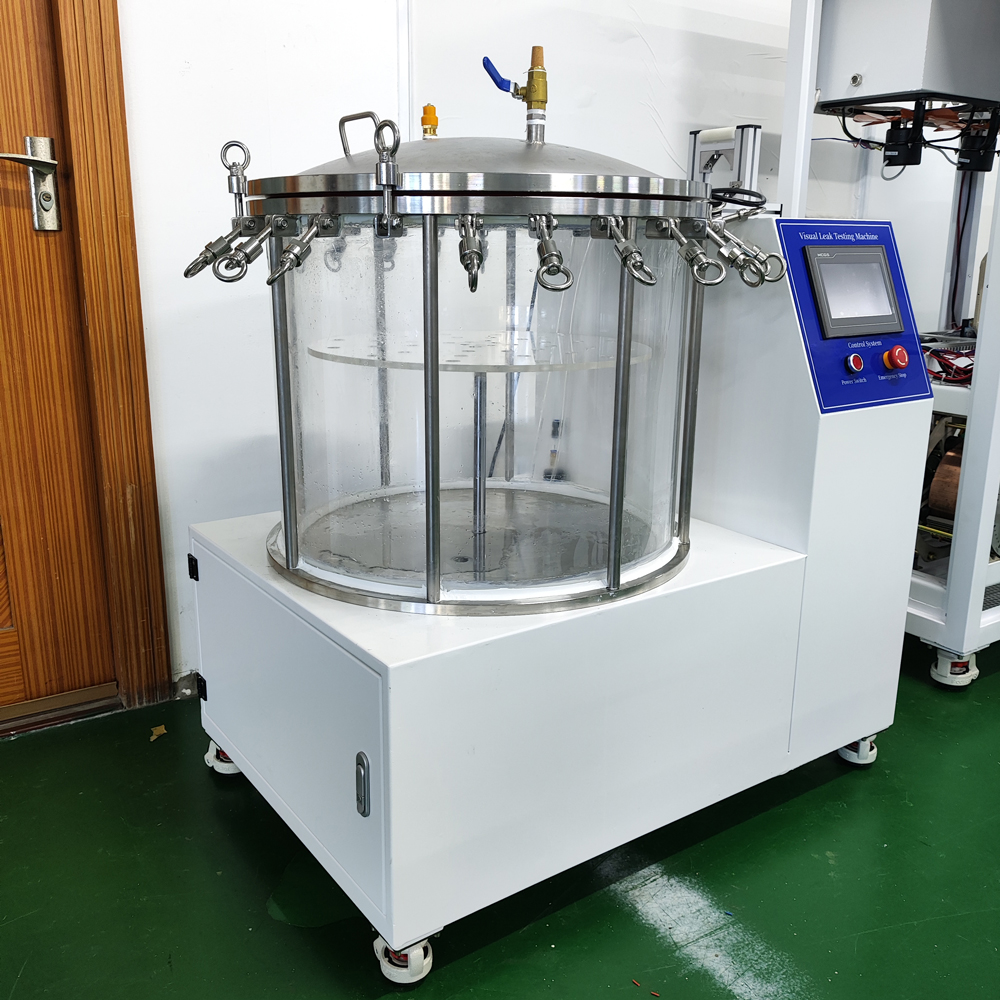
The Air Tightness Tester is a precision testing instrument designed to detect air leakage and evaluate the sealing performance of various products and components. Using advanced pressure measurement and leak detection technology, this equipment helps manufacturers identify potential leakage problems, improve product reliability, and maintain consistent quality standards.
The air leak tester typically uses compressed air to pressurize the test sample and monitors pressure changes to determine whether leakage occurs. Depending on the application, different testing methods, including pressure decay testing and differential pressure testing, can be configured to meet specific inspection requirements.
This air tightness testing equipment is widely used in automotive components, electronic devices, plastic enclosures, valves, connectors, household appliances, medical devices, and other products requiring reliable sealing performance. It is suitable for laboratory testing, incoming inspection, and automated production line quality control.
Featuring programmable test parameters, digital pressure monitoring, and automatic result evaluation, the air tightness tester supports efficient, repeatable, and accurate testing processes. Customized fixtures and test programs can also be developed for different product shapes, sizes, and leakage specifications.
Choosing a reliable air tightness tester helps manufacturers reduce defective products, optimize inspection efficiency, and improve overall production quality. It provides a practical solution for modern industrial leak testing and sealing performance verification.
1. Working principle | It is based on the pressure difference leak detection method. During testing, the sample is placed in a transparent testing tank of a visual leak testing machine, and positive pressure, negative pressure, or water pressure is applied through an automatic control system to create a pressure difference between the inside and outside of the sample. If there is a small leak, gas or water molecules will be expelled from an unsealed area to form bubbles, which can be clearly seen by the testing personnel through the fully transparent acrylic tank of the visible leak testing machine. This method improves the efficiency of disassembly and inspection by 80% compared to traditional water immersion methods, and does not damage the sample. |
2. Application fields | Sealing testing is conducted on products such as underwater lighting fixtures, underwater connectors, underwater sensors, automotive parts, waterproof watches, waterproof phone cases, etc, |
3. Functions | It’s used to evaluate the sealing reliability of products in continuous immersion environments. Fully transparent design, which detects the leakage point of the sample by checking whether there are bubbles after immersion in water, quickly locates whether the product is sealed tightly, and facilitates the design, improvement, calibration, and factory inspection of the product. It is a key tool for research and quality control |
4. Execution standard | IEC 60529: 2001 Degrees of security provided by enclosures (IP Code) GB 4208-2008 Degrees of protection provided by enclosure (IP code) GB 7000.1 -2015 Luminaires Part 1: General Requirements and Tests |
5. Features of the equipment | |
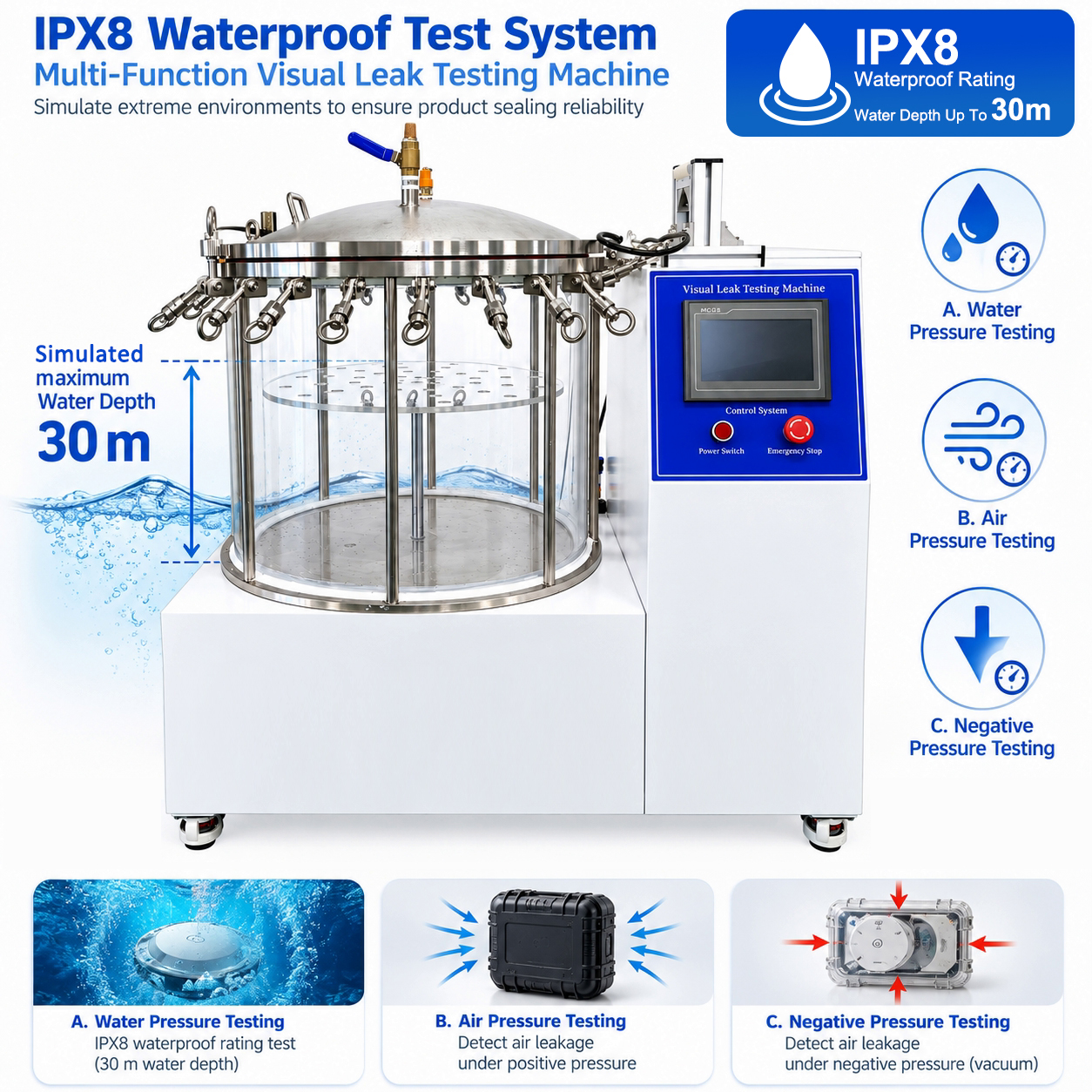
The machine has three testing functions, including the IPX8 waterproof rating testing on products, with a water depth of 30 m. A. Water pressure testing; B. Air pressure testing; C. Negative pressure testing. | |
5.1. Water pressure test | |
5.1.1. Working principle | a. Place the sample on the sample platform inside the testing tank in advance, b. Cover the lid, tighten the screws, set the test pressure and time, and then start the equipment. c. The sample platform immerses the sample in water, increases the air pressure on the water surface to the set value, and then maintains the pressure. If there is a leakage point in the sample, the water will be pressed into the sample, and the air inside the sample will be discharged. The leakage point of the sample can be observed through bubbles. d. The test is completed, and the sample platform rises out of the water with the sample, open the lid and take out the sample. |
5.2. Air pressure testing | |
5.2.1. Working principle | a. Place the sample on the sample platform inside the testing tank in advance, b. Cover the lid, tighten the screws, set the test pressure and time, and then start the equipment. c. The sample platform stops with the sample in the air on the water surface, increases the air pressure on the water surface to the set value, and maintains the pressure. If there is a leakage point in the sample, the air will be compressed into the sample. d. After the holding time is up, the sample platform immerses the sample in water while releasing the pressure on the water surface. At this point, the air pressure inside the sample will be released, and the leakage point of the sample can be identified by observing bubbles. e. The test is completed, and the sample platform rises out of the water with the sample, open the lid and take out the sample. |
5.3. Negative pressure testing | |
5.3.1. Working principle | a. Place the sample on the sample platform inside the testing tank in advance, b. Cover the lid, tighten the screws, set the test pressure and time, and then start the equipment. c. The sample platform immerses the sample in water, vacuumize the water surface to the set value and maintain pressure. If there is a leak in the sample, the air inside the sample will be evacuated and the leak can be observed through bubbles. d. The test is completed, and the sample platform rises out of the water with the sample, open the lid and take out the sample. |
6. Structure and material | |
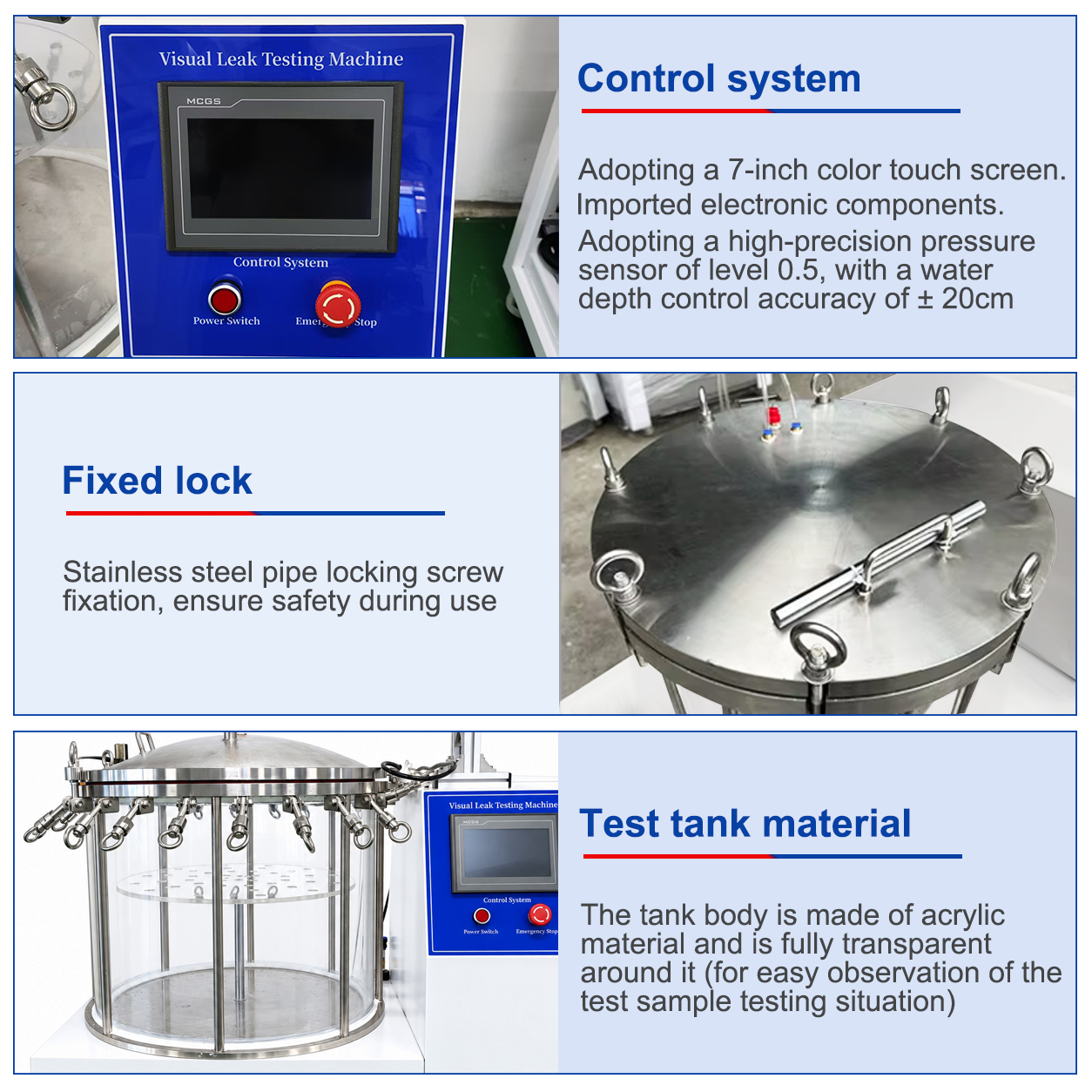
6.1. Test tank material | The tank body is made of acrylic material and is fully transparent around it (for easy observation of the test sample testing situation). The pressure tank has undergone a double pressure withstand test in the factory and is equipped with a safety valve to ensure the safety of users. |
6.2. Special silicone sealing ring | With good elasticity, not easily damaged, and a service life of up to 10 years. |
6.3. Control system | Adopting a 7-inch color touch screen, parameters such as holding time, test pressure, and delayed release time can be set, with full touch operation for easy use. |
6.4. Electronic control components | Imported brands (such as LS, Omron, etc.); The pneumatic components are made of Taiwan's original Yadeke, ensuring the stability and service life of the equipment. |
6.5. Pressure control | Adopting a high-precision pressure sensor of level 0.5, with a water depth control accuracy of ± 20cm |
Phone
+86 13018663273
carleen@sailham.com