
Reliable Test Equipment Manufacturer
As global manufacturing continues to develop, product reliability has become an important consideration across many industries. During storage, transportation, and daily operation, products may be exposed to different humidity levels. Excessive moisture can cause corrosion, material deterioration, electrical instability, and changes in product performance.
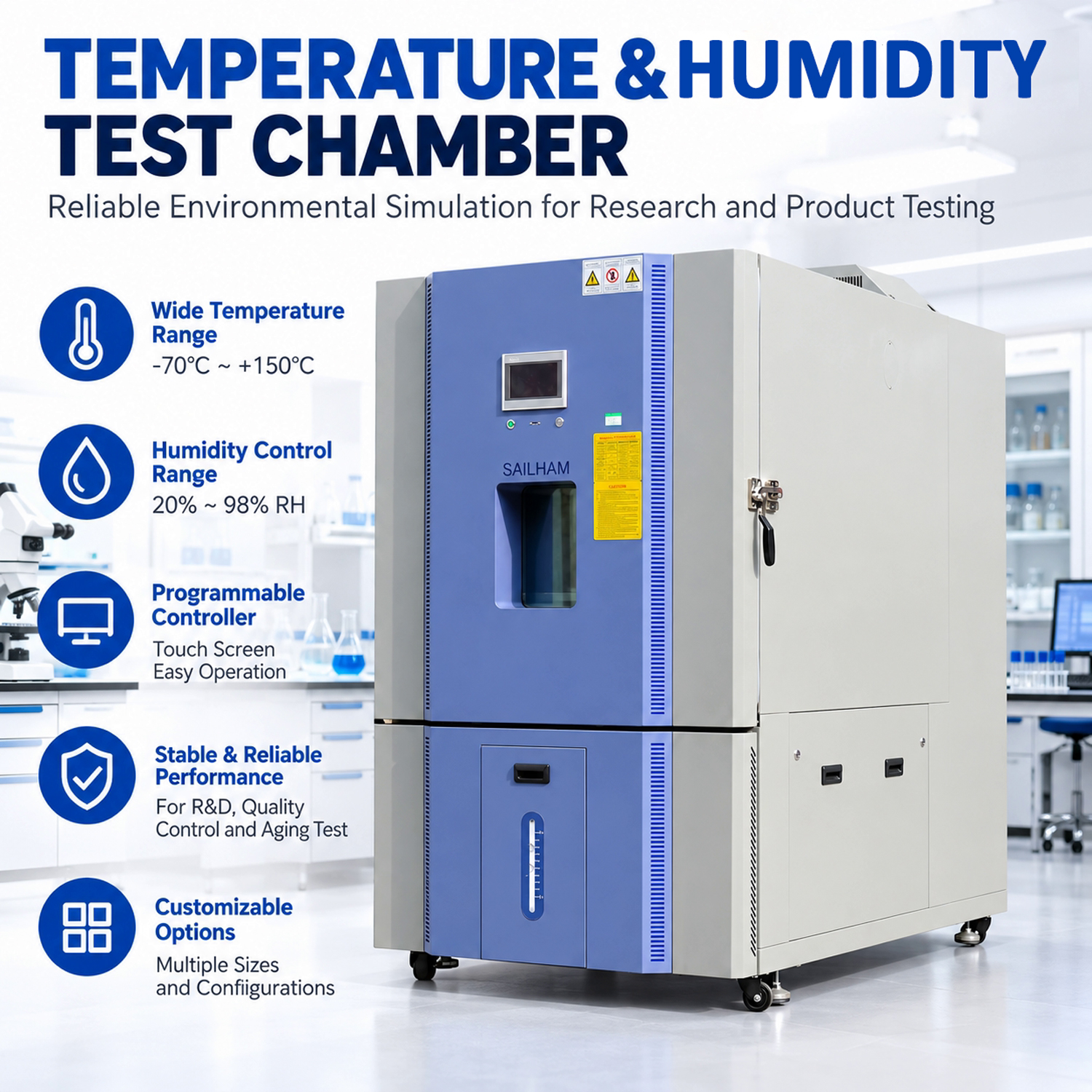
To identify these potential risks, manufacturers are increasingly using environmental testing equipment to evaluate product resistance to moisture. A humidity test chamber provides a controlled testing environment where temperature and relative humidity conditions can be adjusted to simulate different climatic environments.
How Humidity Testing Supports Reliability Evaluation
Humidity testing helps engineers understand how materials and products respond to prolonged exposure to moisture. By maintaining specified humidity conditions inside the chamber, manufacturers can observe changes in product appearance, electrical performance, material properties, and structural integrity.
Depending on the testing requirements, humidity tests may involve constant humidity exposure, temperature and humidity cycling, or damp heat conditions. These testing procedures help identify potential weaknesses before products enter the market.
A reliable humidity test chamber also supports repeatable testing conditions, allowing laboratories to compare samples and evaluate product performance more consistently.
Applications Across Multiple Industries
Humidity testing plays an important role in several manufacturing sectors. Electronics Industry: Electronic components, circuit boards, sensors, and communication devices may be affected by moisture. Humidity testing helps evaluate insulation performance, corrosion resistance, and operational reliability.
Automotive Industry: Automotive electronic systems, connectors, plastic components, and interior materials require environmental evaluation to ensure durability under different climatic conditions.
Materials and Coatings: Plastics, rubber, paints, and protective coatings can experience physical or chemical changes after prolonged moisture exposure. Humidity testing helps assess their resistance and stability.
Pharmaceutical and Packaging Industries: Controlled humidity environments can support product stability studies and packaging performance evaluation under defined test conditions.
The Development of Modern Humidity Testing Equipment
With increasing requirements for product quality, environmental testing equipment is developing toward more precise control, automated operation, and improved test repeatability.
Modern humidity testing systems can provide controlled temperature and relative humidity conditions according to specific testing procedures. Programmable controllers also allow users to establish testing profiles and manage different environmental cycles.
For laboratories and manufacturers, selecting suitable chamber capacity, humidity range, temperature range, and control accuracy is essential to achieving reliable test results.
The humidity test chamber has become an important tool for product reliability evaluation and industrial quality control. By simulating controlled moisture conditions, it helps manufacturers identify potential defects, evaluate material durability, and improve product performance.
As industries continue to prioritize quality and long-term reliability, humidity testing will remain an essential part of product development, material research, and manufacturing inspection.
Phone
+86 13018663273
carleen@sailham.com