
Reliable Test Equipment Manufacturer
Reliable Test Equipment Manufacturer
The development of new materials is becoming increasingly dependent on reliable laboratory data. For products intended to remain outdoors for extended periods, understanding how materials respond to ultraviolet radiation, heat, moisture, and repeated environmental exposure can be critical. As a result, the UV aging test chamber is becoming an increasingly useful tool for manufacturers looking to evaluate material durability before long-term field deployment.
Shortening the Material Evaluation Cycle
Traditional outdoor weathering tests can require long exposure periods and may be affected by seasonal changes, local climate conditions, and inconsistent weather. These factors can make it difficult for engineering teams to obtain comparable results within a short development cycle.
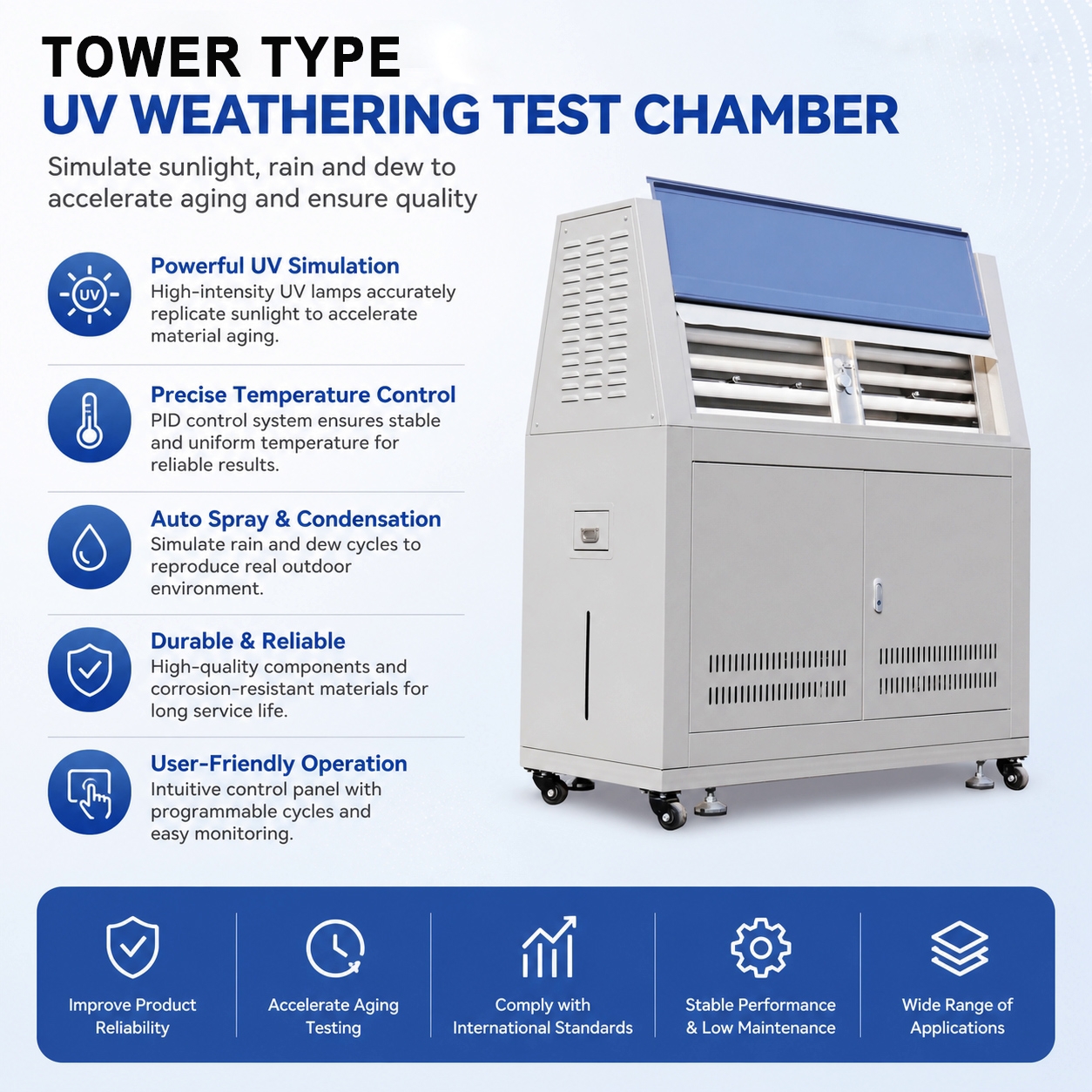
A UV aging test chamber provides a controlled laboratory environment in which selected exposure conditions can be repeated. By using programmed cycles of ultraviolet radiation, temperature, and moisture, laboratories can study material degradation without waiting for years of natural outdoor exposure.
This approach is particularly valuable when manufacturers need to compare several material formulations during research and development.
More Than a Visual Inspection
UV aging testing is often associated with visible changes such as fading or discoloration. However, material degradation can involve much more than appearance.
Depending on the material and application, prolonged ultraviolet exposure may affect surface properties, flexibility, tensile performance, gloss, adhesion, and structural integrity. Coatings may develop cracking or chalking, while plastics and polymers can become brittle after prolonged environmental exposure.
For this reason, a UV aging test chamber is increasingly used as part of a broader material durability evaluation rather than as a simple appearance test.
Supporting Faster Engineering Decisions
One of the main advantages of controlled accelerated weathering is the ability to compare materials under the same exposure program. Engineers can evaluate different raw materials, additives, coatings, formulations, or surface treatments and use the resulting data to guide product development.
Recent market analysis indicates that demand for UV aging test equipment is being supported by applications in automotive, aerospace, electronics, paints and coatings, and plastics. Research and quality-control laboratories are also important end users as manufacturers place greater emphasis on product durability and reliability.
Combining UV, Heat, and Moisture
Real-world outdoor degradation rarely results from ultraviolet radiation alone. Sunlight is accompanied by temperature changes, condensation, rain, and moisture. Modern UV aging test chambers can therefore incorporate different environmental exposure stages to provide a more representative accelerated weathering program.
Depending on the applicable test method, laboratories may use fluorescent UV radiation together with condensation or water exposure. ISO 4892-3:2024, for example, addresses laboratory exposure of plastics to fluorescent UV radiation, heat, and water. This provides a standardized framework for evaluating the weathering behavior of suitable materials.
Improving Confidence Before Mass Production
For manufacturers, early identification of material weaknesses can reduce the risk of costly design changes later in the production cycle. UV aging testing can help development teams determine whether a selected material or coating is suitable for its intended environment and whether additional protection may be required.
As product development cycles become shorter and durability expectations continue to increase, laboratory weathering testing is gaining a stronger position in quality assurance and research programs.
A properly configured UV aging test chamber gives engineers a repeatable platform for studying environmental degradation and generating useful comparative data. For manufacturers developing plastics, coatings, automotive components, outdoor equipment, electronics, and other weather-exposed products, UV aging testing can provide valuable insight before products move from the laboratory to real-world applications.
Phone
+86 13018663273
carleen@sailham.com